The Eastern Mediterranean stands as one of NATO and the European Union’s most geopolitically vulnerable frontiers. While broader European security strategy often focuses on Eastern Europe, Greece faces an immediate, asymmetric posture directly along its eastern borders. Central to Athens’ defense architecture is the imperative to protect its sovereign island chain—a necessity driven by the proximity of Turkish amphibious forces, persistent maritime revisionism, and the unresolved military occupation of northern Cyprus.
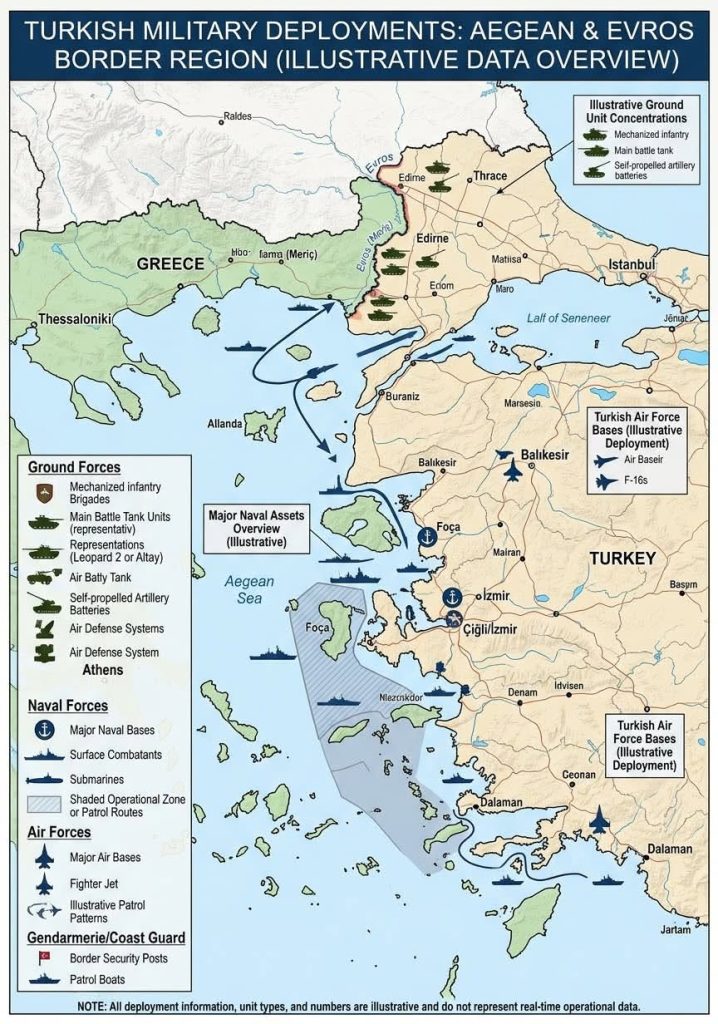
The primary operational rationale for Greece’s military presence on islands like Lesbos, Chios, Samos, and the Dodecanese is the threat posed by Turkey’s Fourth Army—commonly known as the Aegean Army (Ege Ordusu).
Headquartered in İzmir, directly opposite the easternmost Greek islands, the Aegean Army maintains dedicated commando, marine infantry, and landing craft assets outside standard NATO operational command structures.
Several major Greek islands lie only a few nautical miles from the Anatolian coast. Because these islands are separated from mainland Greece by broader stretches of open sea, local military presence serves as an essential immediate deterrent against rapid amphibious or air-assault operations.
For Greek defense planners, the 1974 military intervention and ongoing occupation of 37% of Cyprus by Turkish forces serves as a core historical baseline for territorial integrity concerns.
European security analysts highlight that concepts such as Mavi Vatan (Blue Homeland) project expansive maritime claims across the Eastern Mediterranean, directly overlapping European Exclusive Economic Zones (EEZs) and island rights established under the United Nations Convention on the Law of the Sea (UNCLOS).
Turkey remains one of the few non-signatories to UNCLOS and maintains an official 1995 parliamentary declaration (casus belli) stating that any expansion of Greek territorial waters beyond six nautical miles would constitute a reason for military action.
Article 51 and the Legal Basis for Defense
While Ankara frequently cites early 20th-century treaties (Lausanne 1923 and Paris 1947) to claim the Eastern Aegean islands must remain strictly demilitarized, Athens invokes Article 51 of the United Nations Charter—the inherent right to individual or collective self-defense. From the perspective of European law and Greek national defense, a sovereign nation cannot be required to strip its territory of protective forces when facing concentrated amphibious assets stationed directly across a narrow maritime border.

Leave a Reply